
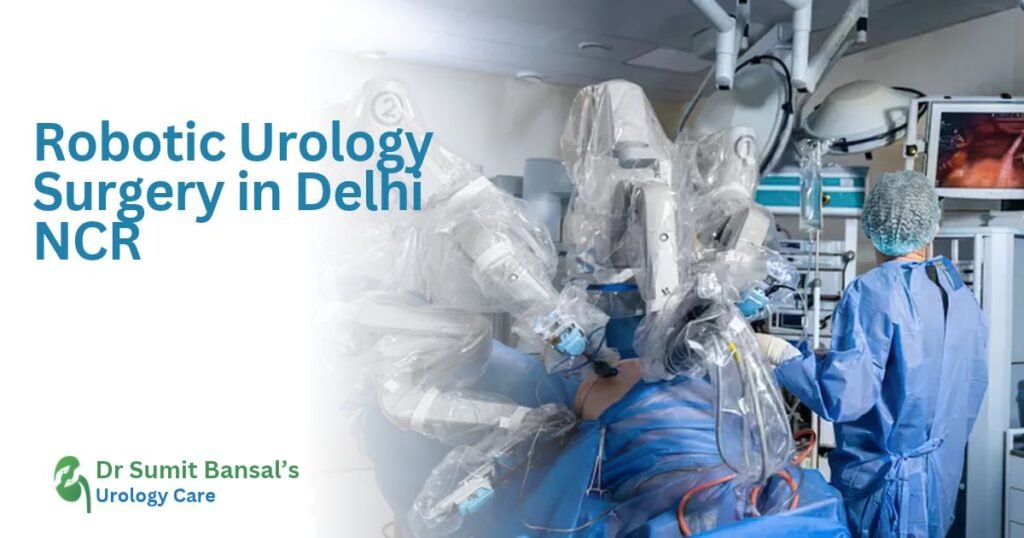
Advances in medical technology have transformed the treatment of many urological conditions. Robotic urology surgery is one such advancement, allowing trained surgeons to perform selected complex procedures using specialised instruments, enhanced visualisation, and precise instrument control.
For patients seeking robotic urology surgery in Delhi NCR, this approach may offer an alternative to traditional open surgery in suitable cases. It is used for selected conditions affecting the prostate, kidneys, urinary bladder, and urinary tract.
Dr. Sumit Bansal, MCh in Urology and Kidney Transplant, MS in General Surgery, and MBBS, is a urologist with expertise in minimally invasive urology, uro-oncology, kidney transplantation, and robotic surgery. He serves as Director and Head of Urology, Renal Transplant and Robotic Surgery at Metro Hospital, Sector 16A, Faridabad.
This article explains how robotic urology surgery works, the conditions it may treat, its potential benefits and risks, and what patients should consider before undergoing a procedure.
What Is Robotic Urology Surgery?
Robotic urology surgery is a minimally invasive surgical technique in which a trained surgeon controls specialised robotic instruments from a console. A high-definition camera provides a magnified view of the surgical area, while the instruments allow precise movements in confined anatomical spaces.
Despite the term “robotic,” the system does not perform surgery independently. The surgeon remains in control of the instruments throughout the operation.
Robotic-assisted surgery may be particularly useful for certain procedures involving the pelvis, kidneys, prostate, and urinary tract, where careful tissue handling and precise reconstruction are important.
The suitability of robotic surgery depends on the patient’s diagnosis, anatomy, medical history, and the surgeon’s assessment.
Conditions Treated With Robotic Urology Surgery
Robotic techniques can be used for several urological conditions. The most appropriate procedure depends on the nature and severity of the disease.
1. Prostate Cancer
Robotic-assisted radical prostatectomy is a surgical option for selected patients with prostate cancer. The procedure involves removing the prostate gland and, when indicated, nearby tissues or lymph nodes.
Potential advantages include improved visualisation and precise instrument control in the confined pelvic region. Surgeons may use nerve-sparing techniques when oncologically appropriate to help preserve urinary control and sexual function.
However, the suitability of nerve preservation depends on the cancer’s location and extent. Robotic surgery cannot eliminate the risks of urinary incontinence, erectile dysfunction, or other complications.
2. Kidney Tumours and Kidney Cancer
Robotic kidney surgery may be considered for selected patients with kidney tumours.
Two common procedures include:
Robotic partial nephrectomy: Removes the tumour while preserving as much healthy kidney tissue as possible, when feasible.
Robotic radical nephrectomy: Removes the entire affected kidney when required by the disease and clinical circumstances.
Partial nephrectomy may be particularly important when preserving kidney function is a priority. The choice between partial and radical nephrectomy depends on tumour size, location, complexity, kidney function, and other clinical factors.
3. Enlarged Prostate (BPH)
Benign prostatic hyperplasia (BPH) is a non-cancerous enlargement of the prostate that may cause difficulty urinating, a weak urine stream, frequent urination, or incomplete bladder emptying.
Many patients can be treated with medicines or endoscopic procedures. Robotic simple prostatectomy may be considered for selected patients with a very large prostate when other approaches are less suitable.
Robotic surgery is not necessary for every patient with an enlarged prostate. Treatment should be based on symptoms, prostate size, complications, and available alternatives.
4. Reconstructive Urology
Some urological conditions require surgery to restore the normal flow of urine or correct a structural problem in the urinary tract.
Selected reconstructive procedures may be performed using robotic assistance, including:
Pyeloplasty: Corrects a narrowing at the junction where the kidney meets the ureter.
Ureteric reimplantation: Repositions the ureter’s connection to the bladder to address selected problems.
Ureteric reconstruction: Repairs certain ureteral strictures or injuries.
Selected reconstructive procedures involving the urinary tract: May be considered when robotic access and reconstruction are appropriate.
These procedures aim to restore urinary drainage, relieve obstruction, and preserve kidney function where possible.
5. Kidney Transplant-Related Surgery
Robotic techniques may be used for selected kidney transplant-related procedures, including living donor nephrectomy at centres with the appropriate expertise and facilities.
In a living donor nephrectomy, a kidney is removed from a carefully evaluated donor for transplantation into a recipient. A minimally invasive approach may reduce incision-related discomfort and support recovery in suitable cases.
Donor safety is paramount. The surgical approach must be selected after a comprehensive assessment of the donor’s health and the kidney’s anatomy.
Benefits of Robotic Urology Surgery
Robotic-assisted surgery offers several potential advantages over conventional open surgery in appropriately selected patients.
1. Small Incisions
Many robotic procedures are performed through several small incisions rather than one large incision. This may result in smaller scars and less disruption to surrounding tissues.
2. Enhanced Visualisation
The camera provides a magnified, three-dimensional view of the operative area, helping the surgeon identify anatomical structures.
3. Precise Instrument Control
Robotic instruments offer a high degree of manoeuvrability, which may be useful during delicate dissection, suturing, and reconstruction.
4. Potentially Less Blood Loss
For certain procedures, robotic-assisted surgery may reduce blood loss compared with open surgery. The extent of this benefit depends on the procedure, the patient’s condition, and the surgeon’s experience.
5. Potentially Shorter Hospital Stay
Some patients can leave the hospital sooner after minimally invasive surgery than after comparable open procedures. Actual discharge timing depends on the complexity of the operation and recovery.
6. Recovery and Return to Routine Activities
Patients may experience less incision-related discomfort and return to routine activities sooner in selected cases. Recovery is not immediate, however, and postoperative instructions must be followed carefully.
Important: These are potential benefits, not guaranteed outcomes. Robotic surgery is not automatically superior to every conventional or endoscopic procedure.
Robotic Surgery vs. Traditional Open Surgery
| Feature | Robotic-Assisted Surgery | Traditional Open Surgery |
|---|---|---|
| Surgical access | Usually small incisions | Generally a larger incision |
| Visualisation | Magnified 3D view in many systems | Direct surgical view |
| Instrument control | Surgeon-controlled robotic instruments | Instruments controlled directly by the surgeon |
| Blood loss | May be lower in selected procedures | Depends on procedure and clinical circumstances |
| Hospital stay | May be shorter for suitable cases | May be longer for comparable operations |
| Recovery | May be faster in selected cases | Depends on the procedure and incision |
| Suitability | Depends on disease, anatomy, and available expertise | Remains appropriate for certain complex or specific cases |
Is Robotic Urology Surgery Safe?
Robotic-assisted urological surgery is an established option for several procedures when performed by appropriately trained surgical teams.
Nevertheless, robotic surgery carries risks similar to those associated with other major operations, including:
Bleeding and infection.
Anaesthesia-related complications.
Injury to surrounding organs or structures.
Blood clots.
Urinary leakage or obstruction, depending on the procedure.
Procedure-specific complications, such as urinary incontinence or erectile dysfunction following prostate surgery.
The risk profile varies with the condition being treated, the patient’s overall health, and the complexity of the operation.
Before surgery, patients should discuss expected benefits, possible complications, alternatives, and recovery requirements with their urologist.
What to Expect Before and After Robotic Urology Surgery
Before Surgery
The surgical team may recommend blood tests, urine tests, imaging, cardiac evaluation, or other investigations according to the planned procedure.
Patients should inform their doctor about existing medical conditions, allergies, and all medicines they take, especially blood thinners. Medicines should only be stopped or adjusted on medical advice.
The surgeon will explain the planned procedure, anaesthesia, potential risks, and expected recovery.
During Surgery
The patient receives anaesthesia, and the surgical team positions the robotic instruments through small incisions when appropriate. The surgeon controls the instruments from a console while trained team members assist at the operating table.
The duration of surgery varies according to the procedure and its complexity.
After Surgery
Postoperative care may include pain management, wound care, early mobilisation, and monitoring of kidney function or urinary drainage, depending on the operation.
Some patients may temporarily require a urinary catheter or drainage tube. The timing of discharge and return to work varies by procedure and individual recovery.
Follow-up appointments are important for assessing healing, reviewing test results, and identifying any complications.
Why Choose Dr. Sumit Bansal for Robotic Urology Surgery in Delhi NCR?
Dr. Sumit Bansal is a urologist with qualifications including MCh in Urology and Kidney Transplant, MS in General Surgery, and MBBS. His clinical expertise includes minimally invasive urology, uro-oncology, kidney transplantation, endourology, laparoscopy, and reconstructive urology.
He serves as Director and Head of Urology, Renal Transplant and Robotic Surgery at Metro Hospital, Sector 16A, Faridabad.
Patients seeking robotic urology surgery can benefit from a detailed consultation to understand their diagnosis, available treatment approaches, expected outcomes, and potential risks.
An individualised treatment plan helps ensure that the recommended surgical technique is appropriate for the patient’s condition and clinical needs.
To learn more about Dr. Sumit Bansal’s qualifications and urological services, visit his official website:
Frequently Asked Questions (FAQs)
1. What is the cost of robotic urology surgery in Delhi NCR?
The cost varies according to the procedure, hospital facilities, duration of admission, investigations, and the patient’s medical condition. Contact the hospital for a personalised estimate after consultation.
2. Is robotic surgery better than laparoscopic surgery?
Not in every situation. Robotic surgery offers enhanced instrument manoeuvrability and visualisation, which may be helpful in selected complex procedures. Conventional laparoscopy can also provide excellent outcomes. The best approach depends on the operation and the surgeon’s expertise.
3. How long does recovery take after robotic urology surgery?
Recovery varies by procedure. Some patients resume light activities within days, while others need several weeks before returning to work or strenuous activity. Follow your surgeon’s specific instructions.
4. Is robotic surgery used for prostate cancer?
Yes. Robotic-assisted radical prostatectomy is an established surgical option for selected patients with prostate cancer. Suitability depends on the cancer stage, overall health, and the treatment plan.
5. Can robotic surgery treat kidney tumours?
Yes. Selected kidney tumours can be treated using robotic partial or radical nephrectomy. The decision depends on tumour characteristics, kidney function, and whether preserving healthy kidney tissue is feasible.
6. Does robotic surgery guarantee faster recovery?
No. Minimally invasive surgery may support faster recovery in suitable cases, but recovery depends on the procedure, individual health, and any complications.
7. Where can I consult Dr. Sumit Bansal for robotic urology surgery?
Dr. Sumit Bansal serves at Metro Hospital, Sector 16A, Faridabad. For current consultation availability and appointment details, visit his official website at https://drsumitbansal.com/.
Conclusion
Robotic urology surgery has expanded the treatment options available for selected prostate conditions, kidney tumours, urinary tract problems, and reconstructive urological conditions. Its potential advantages include magnified visualisation, precise instrument control, smaller incisions, and recovery benefits in appropriate cases.
However, successful treatment depends on accurate diagnosis, careful patient selection, the surgeon’s expertise, and comprehensive postoperative care.
If you are considering robotic urology surgery in Delhi NCR, consult Dr. Sumit Bansal to discuss your condition and understand which treatment approach may be suitable for you.